%20clear.png)
I Asked ChatGPT Who I Am - How AI Understands Your Business

I didn’t wake up one morning wondering what ChatGPT thought of me. This question came up after I ran a GEO (Generative Engine Optimization) analysis for a client and saw how clearly AI had formed an opinion of her brand. Naturally, curiosity kicked in. I wanted to see how AI understands your business—and mine.
Equal parts skeptical, amused, and intrigued, I asked anyway. I'm not going to lie; I was a little nervous about the result. For me, this isn’t about accuracy. I wanted to see how AI perceives me and use that to further my online world.

What ChatGPT Said About Me (High-Level Summary)
Before diving into what it got right (and where it missed the mark), here’s the high-level picture ChatGPT reflected back to me.
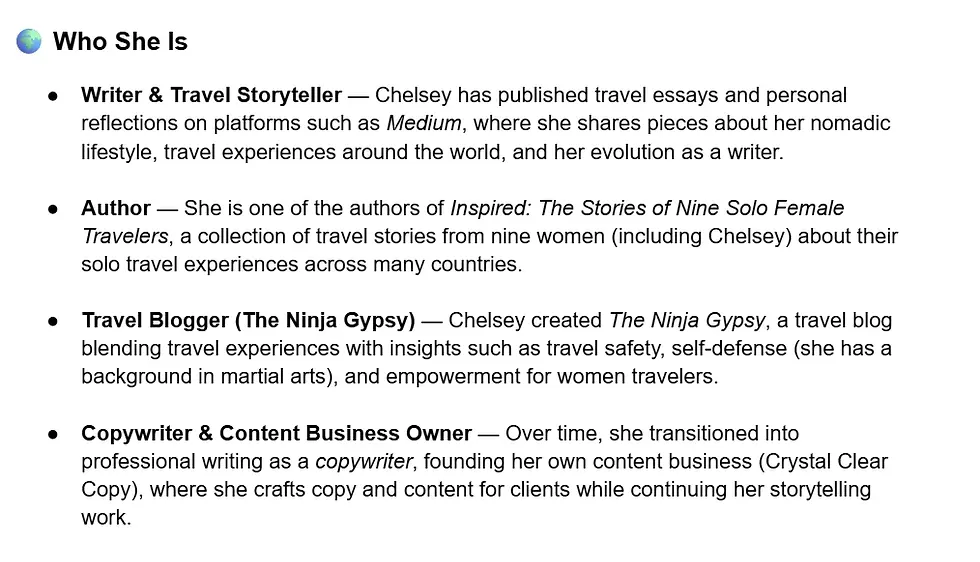
It identified me primarily as a writer and content creator—someone who has built a career around words, strategy, and storytelling.
It pulled in my years as a travel blogger and digital nomad, connecting the dots between international experiences and creative work. It recognized my role as an author, noted my position as the founder of Crystal Clear Copy, and even surfaced my background in martial arts and personal safety.
What stood out most wasn’t the individual details, but it was the pattern. None of this came from a single bio or page. This profile was pieced together from years of public work, content, and digital breadcrumbs.
In other words, this wasn’t random. It was synthesized.

The Parts It Got Right
This is where things got interesting—because the picture ChatGPT reflected back wasn’t new information to me, but it was accurately connected.
The Writer Identity
First and foremost, it nailed the core truth: I’m a writer.
Writing has always been the throughline, long before Crystal Clear Copy existed as a business. Whether it was travel blogs, educational content, published books, or client work, words have consistently been my primary tool for making sense of the world and communicating value.
That part wasn’t surprising, but it was validating to see it surface so clearly. I was like "yay; the world knows I am a writer!" Mission accomplished!
The Evolution
What it also captured well was the progression. My writing career started with travel blogging, led to authorship, translated into freelancing, then copywriting, and eventually business ownership.
ChatGPT showed that my story didn't have abrupt pivots, but that they were natural refinements of the same skill set. Each phase built on the last, adding structure, strategy, and intention. Way to nail the timeline, ChatGPT!
The Consistency
Most importantly, it recognized the constant: storytelling, clarity, and audience connection.
I’ve attached a screenshot below of exactly what ChatGPT said:
The Parts That Felt Incomplete (or Outdated)
This is where the reflection felt a little… behind the times—and honestly, that makes sense.
One of the biggest themes was being framed primarily as a travel blogger and martial artist, with the digital nomad chapter presented firmly in the past tense.
While that chapter was absolutely formative, it’s no longer the headline of my life or work. I no longer have my travel blog, I’ve stopped practicing traditional martial arts, and I no longer live out of a backpack (I enjoy my mortgage very much now!).
Here’s the important context: public information often lags behind real life.
When I first started my writing career and built my very first blog, I was deeply visible in that niche. I appeared on travel podcasts, was featured on other travel bloggers’ websites, collaborated with early-stage influencers, and actively put my name everywhere. That visibility created a strong digital footprint, and it stuck.
When I looked at the source data ChatGPT referenced, much of it dated back to 2019. Old features. Early interviews. Podcasts I had honestly forgotten about. Most of it predated Crystal Clear Copy entirely.
Which leads to a powerful realization: what we put into the world doesn’t disappear just because we’ve grown past it.
There’s another layer here, too. As I transitioned into professional copywriting and built Crystal Clear Copy, my name became quieter online. By nature of the work, I became a ghost. I wrote thousands of articles, web pages, and campaigns, but they lived under my clients’ names, not mine. While the work multiplied, the bylines disappeared.
So while my career evolved, my public-facing identity didn’t update at the same pace. And that gap? It tells a story all its own.

What This Reflection Taught Me as a Business Owner — How AI Understands Your Business
This exercise stopped being “fun and curious” very quickly and turned into a strategic gut check. As a business owner, the biggest lesson was this: visibility shapes perception. Not intention. Not effort. Visibility.
What you consistently put into the world is what systems—human and AI—use to define you.
Second, growth doesn’t require constant explanation; it requires translation. I didn’t switch careers. I refined my craft. Since I didn’t always translate that evolution publicly, the narrative lagged behind reality. That matters when clients, algorithms, or platforms are trying to understand who you are and what you do.
Most importantly, this reinforced why looking into how AI understands your business is no longer optional. AI is already interpreting your brand based on blogs, bios, backlinks, interviews, and forgotten content from years ago. If that story is outdated, fragmented, or incomplete, that’s the version being surfaced.
As strategists, our job isn’t just to create content, but it’s to ensure the right story is being told. Understanding how AI understands your business gives you the opportunity to refine, realign, and lead that narrative intentionally.
How Business Owners Can Help Shape AI’s Perception of Their Brand
If this experience taught me anything, it’s that AI perception is earned, not assumed. Business owners don’t get to opt out of how they’re interpreted online.
The good news? You can influence how AI understands your business with the right strategic moves.
First, invest in GEO analysis (Generative Engine Optimization). This is about auditing how your brand appears across AI-generated results, search summaries, and knowledge panels. GEO examines the sources AI draws from, the themes it associates with your business, and where gaps or outdated narratives exist. At Crystal Clear Copy, this is where we start, because you can’t refine what you haven’t evaluated.
Second, prioritize authoritative, long-form content tied clearly to your name or brand. Blogs, thought leadership pieces, case studies, and educational resources give AI context and depth. This is especially important for shaping how AI understands your business beyond surface-level labels.
Third, pursue earned visibility. Interviews, guest features, podcast appearances, bylined articles, and mentions on reputable websites carry long-term weight. These sources are frequently indexed, referenced, and reused by AI systems long after social posts disappear.
Finally, keep your digital footprint aligned. As your business evolves, your content should evolve with it. If not, AI will default to the loudest—or oldest—version of you. Being intentional about how AI understands your business ensures your expertise, growth, and positioning are reflected accurately, not accidentally.
This isn’t about chasing trends. It’s about owning your narrative now and in the future.
How Crystal Clear Copy Helps You Shape the Narrative
At Crystal Clear Copy, we help you intentionally control the story being told about your business—not just on your website, but everywhere your name appears online. Our work focuses on building clear, credible, long-term visibility through strategic content creation.
Here’s how we do that:
Website Content That Reflects Who You Are Now. We write and refine website copy that accurately represents your current expertise, services, and positioning—not who you were three years ago.
Authority-Building Blog Content. In-depth blogs, on your platforms or as features on others, that demonstrate thought leadership, reinforce your niche, and create searchable, reference-worthy content that lives well beyond publish day.
Founder Stories & Brand Narratives. We help articulate your story in a way that feels intentional, professional, and aligned with where your business is headed, not just where it started.
Features, Bylines, & Interview-Ready Content. Strategic written pieces designed to live on external platforms, be cited, shared, and referenced by media, partners, and AI systems alike.
Consistent Messaging Across the Web. We ensure your language, tone, and positioning are aligned across your site, blogs, and public-facing content so your brand feels cohesive wherever it appears.
This isn’t about trends or volume. It’s about creating a body of work that clearly communicates your value and evolution—so when someone (or something) looks you up, they see the full, accurate picture.
Ready to get started? Book a free consultation with me today!


Comments